

Table of Contents
-
Why your brain freezes when it matters most (and what FBI negotiators do differently)
-
The 'We'll Think About It' Trap – Chris Voss's 24-year FBI solution
-
When clients say you're too expensive – Cialdini's psychology flip
-
After 3 weeks of silence – Carnegie's no-pressure follow-up
-
The Smarter Way: Persuasion GPT for real-time conversations
I just finished presenting to 15 people on Zoom. Walked them through the entire framework. Showed case studies. Got nods, engagement, good questions.
At the end, I pitched my service. "If you'd like help implementing this, I'm taking on 3 new clients next month. Raise your hand or drop a message in chat if you want to discuss."
Nothing.
Complete silence.
I checked if my Zoom froze. Moved my mouse. Still live. Nobody moving. No chat messages. Just 15 tiny boxes staring back at me.
That 8-second silence felt like 8 minutes.
Finally someone unmuted: "Great presentation, thanks so much for sharing this." Meeting ended and zero conversions.

Why Your Brain Empties Out When It Matters Most
What killed that pitch wasn't my offer or my pricing. I froze. I didn't know what to say when the room went silent so I said nothing and watched 15 potential clients politely escape.
This happens everywhere. Client says "we'll think about it" and I say "sounds good!"
-
Boss deflects when I ask for a raise.
-
Prospect ghosts after a great call.
-
Invoice is 60 days late and I can't find the words that don't sound desperate.
Turns out I'm trying to wing what FBI negotiators, psychologists, and relationship experts spent decades mastering. Chris Voss negotiated hostage situations for 24 years. Robert Cialdini studied influence his entire career. Dale Carnegie interviewed 500 successful people to figure out how they influenced others.
They built frameworks while I'm improvising in 3 seconds while my heart pounds.
What changed everything: I stopped trying to be naturally persuasive. I started loading their frameworks into AI before I needed them and now I walk into conversations prepared instead of hoping I'll think of something good.
Let me show you three situations where this works.
1. The 'We'll Think About It' Trap (And Voss's 24-Year FBI Solution)
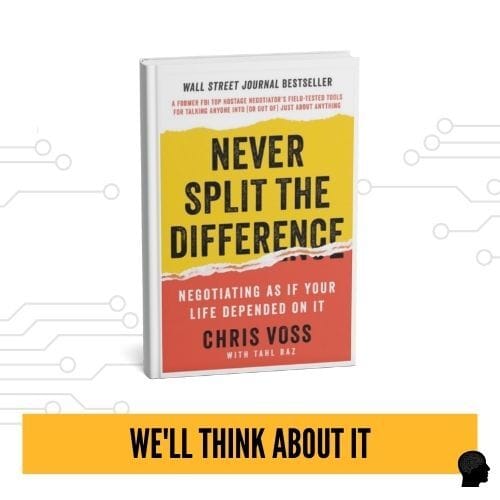
You just finished a great sales call. They loved everything. Great energy. Then: "This sounds perfect. Let me discuss with my team and circle back next week."
You know this is the moment. Most deals die right here.
Framework: Chris Voss (Never Split the Difference)
Voss spent 24 years as an FBI hostage negotiator. His approach: tactical empathy plus calibrated questions.
Tactical empathy means you show you understand their position without agreeing with it. Calibrated questions are open-ended, start with "what" or "how," and make them solve your problem.
When someone says "we'll think about it," they either have an unstated objection or they're being polite. A calibrated question forces them to articulate which one it is.
What to Input
-
What they liked: Specific things they responded positively to during your call
-
Their exact phrase: The words they used when pulling back ("we'll think about it" / "need to discuss internally" / etc.)
-
Energy shift: When did they hesitate? What was happening right before?
-
Who decides: Are they solo or need approval from someone else?
The Prompt:
I'm on a sales call and heard "we'll think about it and get back to you."
Use Chris Voss's negotiation tactics to respond in the moment.

CALL CONTEXT:
- What they liked: [specific positive comments they made]
- Their exact hesitation phrase: [their words]
- Energy shift: [when did they pull back? what triggered it?]
- Who decides: [solo / needs approval from X / committee]

CREATE 3 RESPONSE OPTIONS:
Each must:
- Use a LABEL that mirrors their emotion ("It seems like..." / "It sounds like...")
- Follow with a calibrated question (starts with "what" or "how")
- Create safety for them to share the real objection
- Be 2-3 sentences MAX
- Sound like something YOU would actually say

Calm and curious. Not pushy. Like you're helping them think through it.

AVOID: "I understand where you're coming from" / "I hear you" / sales script language
Example Output:
Option 1: "It seems like the price caught you off guard. What about the investment feels risky right now?"
Option 2: "It sounds like you're worried about getting buy-in from your CFO. How do you usually approach tech purchases with them?"
Option 3: "It feels like there's something specific that doesn't quite fit. What would need to change for this to be an obvious yes?"
Why This Works:
The label ("sounds like you're not entirely sure") shows empathy. The question ("what would need to happen") makes them either state the real objection or realize there isn't one.
If they say "honestly we're comparing a few options," now you know you're in a comparison game. If they say "just need final budget approval," you know it's a process issue, not a you issue.
When to use Voss: Negotiations, objection handling, stalls, conflicts, anytime someone is hesitant but won't tell you why.
2. When Clients Say You're Too Expensive: The Psychology Flip
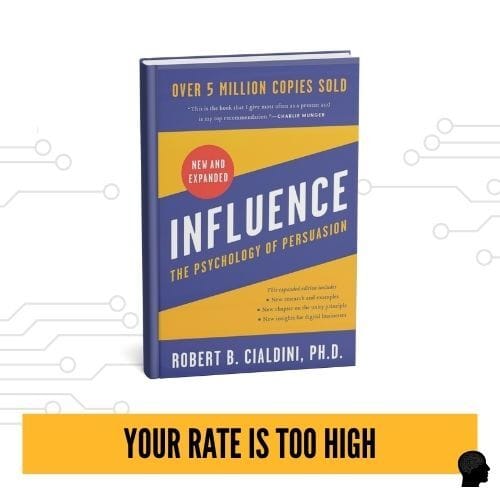
Client says: "I like your work, but your rate is higher than expected. I was thinking $5K, not $8K."
Framework: Robert Cialdini (Influence)
Cialdini identified 7 principles of persuasion. Three work best for pricing objections.
Contrast: Perception is relative. $8K feels expensive alone. Next to $15K, it's a steal.
Scarcity: People value what might become unavailable. Real deadlines create action.
Social Proof: We follow what similar people do. "Others like you chose this" is incredibly powerful.
What to Input
-
The numbers: Your rate, their budget, and whether you can flex on scope
-
Their exact words: How they said it's too expensive (reveals their reference point)
-
Their situation: Business context that affects how they view budget
-
Your proof: Specific results with numbers from similar clients
The Prompt:
A client said my rate is too high.

THE NUMBERS:
- My rate: $X
- Their budget: $Y
- Can I flex on scope? [yes/no - if yes, what's adjustable?]

THE SITUATION:
- Their exact words: ["that's too expensive" / "out of our budget" / other]
- Client type: [first-time / repeat / referred by X]
- Their business situation: [growing/stable/budget-conscious]

WHY I'M WORTH IT:
- Specific results: [X achieved Y result in Z timeframe] (list 2-3 with numbers)
- What I do differently: [the thing others don't do that matters here]

CREATE 3 RESPONSES using:
1. CONTRAST: Compare to cost of NOT solving this problem
2. SOCIAL PROOF: Specific client story at my rate (industry/results)
3. SCARCITY: Only if TRUE (limited slots / other)

Each response: 2-3 sentences. Confident but not defensive.

AVOID: "investment in your business" / "you get what you pay for" / justification language
Example Output:
Option 1 - CONTRAST: "I get it - $8k feels like a lot compared to $5k. Here's what I'm seeing though: you're currently spending about $15k a month on ads that aren't converting. Six months of that is $90k burned. The real question is whether spending $48k to fix that problem is worth saving the other $42k."
Option 2 - SOCIAL PROOF: "Last year I worked with a B2B SaaS company at this exact rate. They were in the same spot - doing $40k MRR, couldn't figure out why paid wasn't working. Four months in they hit $95k MRR. The founder told me later that hesitating on price would've cost them six figures in delayed growth."
Option 3 - SCARCITY: "I only take on two clients at a time because the work requires deep integration with your team. I'm finishing up with one client end of next month, so there's a spot. But I should mention - I have two other conversations happening this week for that same slot. If timing doesn't work on your end, totally understand."
Why This Works:
Contrast: $8K suddenly feels reasonable compared to $15K-$20K.
Social Proof: A named client in their industry is more convincing than "I'm experienced."
Scarcity: Real deadline creates urgency without feeling pushy.
When to use Cialdini: Pricing conversations, positioning, proposals, anytime you need to justify value or create urgency.
3. After 3 Weeks of Silence: Carnegie's No-Pressure Follow-Up
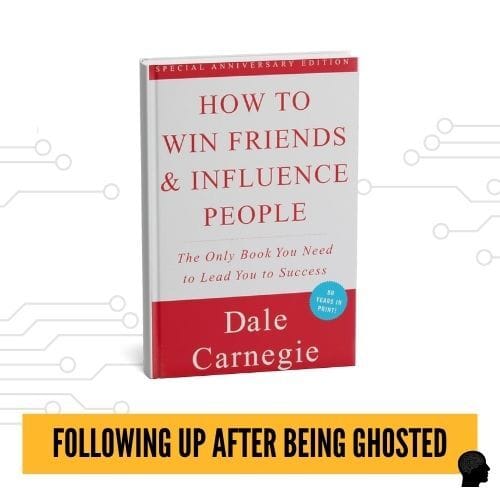
Great conversation 3 weeks ago. They loved the approach. Said they'd think about it and get back to you and now it's been 21 days of silence.
You need to follow up but every draft sounds desperate or pushy. "Just checking in" feels weak. "Wanted to circle back" sounds salesy. "Did you make a decision?" sounds impatient.
Framework: Dale Carnegie (How to Win Friends and Influence People)
Carnegie's philosophy: People care what they want, not what you want. Frame everything around their interests, not yours.
Three principles for ghosting follow-ups:
-
Make them feel important - Their judgment matters, their time matters
-
Frame around their interests - You're trying to help them, not sell them
-
Genuine interest - Relationships over transactions
What to Input
-
Who they are: Their role/context (potential client, networking contact, etc.)
-
What you discussed: The specific topic or problem you talked about
-
When: How long ago (helps calibrate urgency)
-
What they liked: Specific thing that resonated with them
The Prompt:
I had a great conversation with someone 3 weeks ago and they've gone silent.

Who they are: [e.g., "potential client", "prospect from networking event"]
What we discussed: [e.g., "automating their client onboarding process"]
When: [e.g., "3 weeks ago"]
What they liked: [e.g., "they loved cutting onboarding time in half"]

Create a 3-4 sentence follow-up message that:
- Acknowledges they're busy (makes them feel respected)
- References something specific from your conversation
- Frames around helping them (not "do you want to buy")
- Gives them an easy out if timing isn't right
- Feels like a genuine check-in, not a sales push

Warm but professional. Like reaching out to someone you respect.
Example Output:
"Hey [Name], I know you've probably been swamped these past few weeks. I've been thinking about our conversation on cutting your onboarding time in half. I actually came across an approach that might work even better for your specific setup. If timing's still not right, totally understand. But if you want to see it, I'm happy to send over a quick 2-minute overview. Either way, hope things are going well."
Why This Works:
"I know you've probably been swamped" acknowledges their reality. You're not assuming they ghosted because they're not interested. You're assuming they're busy (which they probably are).
"I've been thinking about..." shows you remember the specific thing they cared about. This isn't a mass follow-up template. It's personal.
"If timing's still not right, totally get it" gives them permission to say no without guilt. This reduces their stress about responding, which ironically makes them more likely to respond.
"Either way, hope things are going well" ends with genuine interest in them as a person. Not just a transaction.
When to use Carnegie: Reconnecting with cold contacts, following up without being pushy, asking for favors, networking, maintaining relationships, any situation where you'll work with this person again and want to preserve goodwill.
The Smarter Way: Persuasion GPT
These prompts work great when you have time to prep. But what about the real-time moments?
Client calls unexpectedly: "Your competitor quoted me $3K less."
Boss pulls you aside and you have 30 seconds to pivot the conversation.
Prospect ghosts and you need a follow-up that doesn't sound desperate.
We built the Persuasion GPT for exactly this. It knows all three frameworks and applies the right one based on your situation.
How it works:
-
Describe your situation in plain English
-
It asks clarifying questions
-
Recommends which framework to use
-
Generates 3 response options in your voice
-
Explains the psychology so you learn the patterns
What's inside:
7 categories: Sales & Closing, Pricing & Negotiations, Difficult Conversations, Asking for Favors, Client Management, Career Conversations, Networking & Relationships.
50+ pre-loaded scenarios with examples.
Voice customization so responses sound like you.
Real-time mode for immediate responses.
The investment:
Persuasion GPT is included in Smarter Solutions. One-time payment, lifetime access, every update included.
The prompts in this article work on their own. Use them. Test them. See what happens when you stop freezing.
Pick One Situation You're Avoiding This Week
Pick one situation you're avoiding. A pricing conversation. A difficult client. A raise you need to ask for.
Load the framework. Use the prompt. See what happens when you stop improvising expert persuasion.
The "we'll think about it" moments won't disappear. But you won't freeze anymore.
Try one prompt this week.
See you next Tuesday.
~ Ryan & Max
PS - Share this with someone who keeps saying "I should have said..." after important conversations.
