

Table of Contents
-
The Sunday Night Realization - How Jake's 12 years of experience became "nothing to say"
-
What Happens When You Stay Silent - Your competitors build authority while your expertise collects dust
-
The Pattern Recognition Exercise - Discover your actual specialty (hidden in your resume bullet points)
-
The Results Mining Exercise - Turn every achievement into 3-4 pieces of content
-
The 10 Content Angles Extraction - Extract what you can authentically teach others
-
From Content Angles to Signature Pieces - Build your unique frameworks from years of experience
Sunday night in San Francisco. Weekend winding down. My friend Jake and I sitting in our AirBnb, looking at our watches knowing we have to wake up early to catch our flight back to reality. He's been nursing the same problem for months.
"I have all this experience," he says, scrolling through LinkedIn on his phone. "Twelve years at three solid companies. Real accomplishments. But I struggle to create content that showcases it. I see other people posting thought leadership stuff and I just don't know what to say that doesn't sound boring."
I hear this all the time. The more experience you have, the harder it is to talk about it. Everything feels obvious to you now. You forget what was interesting about your journey. You forget that what feels normal to you is valuable to someone else.
"Let me see your resume," I said.
He looked confused. "My resume? What does that have to do with LinkedIn posts?"
"Everything."

We spent the next 90 minutes going through his resume line by line. Not looking at job titles or generic responsibilities. Looking for patterns. Looking for the stories buried in bullet points. Looking for the content that was already there.
By the end of that Sunday night, Jake had 10 specific content angles he could write about tomorrow, 3 signature pieces based on his unique experience, a clear understanding of what made his perspective different from everyone else in his field, and the first draft of his next LinkedIn post. All extracted from the resume he already had.
Your resume isn't just a record of where you worked. It's a content roadmap. Every role is a story. Every result is a lesson. Every company is context that makes your insights specific instead of generic. You don't need to invent new ideas. You need to extract the expertise you've already accumulated.
Here's exactly how we did it.
What Happens When You Stay Silent
Your competitors are building authority while you stay quiet.
That coworker who posts consistently? They just got invited to speak at the industry conference. You have more experience, better results, deeper expertise. But nobody knows it because you're not talking about it.
Recruiters and clients find people through content now. Every week you don't post is a week someone else builds the relationships that lead to your next opportunity. Your silence isn't neutral. It's expensive.
Another Sunday night staring at LinkedIn. Another hour trying to think of something to post. Another week of "I should do this" but having no idea where to start.
Twelve years of lessons learned, problems solved, expertise built. All sitting in your head instead of out in the world where it could help people and advance your career.
Watching everyone else share their thoughts while you stay quiet. Telling yourself you don't have anything interesting to say even though you've accomplished more than most of the people posting. The gap between your experience and your visibility gets wider every single week.
Meanwhile, the people with half your expertise are out there building personal brands, getting opportunities, making connections. Not because they're better. Because they're willing to talk about what they know.
The Pattern Recognition Exercise
First question: "What's the pattern in your last three roles? Not your job title. Not your industry. What underlying problem were you solving?"
"I did operations work," he said. "You know, normal operations stuff."
"Okay, but look at the companies. Look at what was happening. What made each role hard?"
We made a simple list:
-
Company 1: Series B startup that got acquired during his time there
-
Company 2: Scale-up during hypergrowth phase (30 to 200 people in 18 months)
-
Company 3: Established company going through digital transformation
I pointed at the screen. "You weren't just doing operations. You were doing operations in environments where normal approaches don't work. That's your angle."
The pattern: He specialized in building systems during chaos. Not because he planned his career that way. Because that's where he kept ending up and learning how to handle it.
Before: "I'm an operations manager with 12 years experience"
After: "I specialize in building scalable operations systems during periods of rapid change"
Generic positioning creates generic content. Specific positioning creates specific content that only you can write.
Jake could suddenly see content everywhere:
-
"How I built an onboarding system during a company acquisition"
-
"What I learned about operations while scaling from 30 to 200 people"
-
"The approach that worked when normal operations frameworks failed"
All from looking at the pattern in his resume.
The Results Mining Exercise
Second question: "What results are on your resume? Don't skip the numbers. Tell me what you improved, launched, or changed."
"I have some bullet points with results but they feel like just... normal work outcomes?"
Every result on your resume is a content angle. Every improvement you made is a lesson you learned. Every number is proof that your approach worked. We went through each bullet point that had a number:
Resume Bullet: "Reduced customer churn by 23% through improved onboarding process"
The Content Hidden Inside:
-
Post 1: "How we cut churn by 23% (and it wasn't about the product)"
-
Post 2: "The onboarding mistake that was costing us 1 in 4 customers"
-
Post 3: "What our data revealed about why customers were leaving"
-
Signature Piece: "The Customer Onboarding Audit: 5 questions that revealed our churn problem"
Four pieces of content from one resume bullet point.
Another Resume Bullet: "Led cross-functional team to deliver platform migration 3 weeks ahead of schedule"
The Content Hidden Inside:
-
Post 1: "The project planning mistake that makes everything late"
-
Post 2: "How to run cross-functional projects when no one reports to you"
-
Post 3: "What 'ahead of schedule' means (and why most teams get it wrong)"
Every result has a problem you solved, an approach you took, a lesson you learned, and proof that it worked. That's not just a resume bullet. That's 3-4 pieces of content.
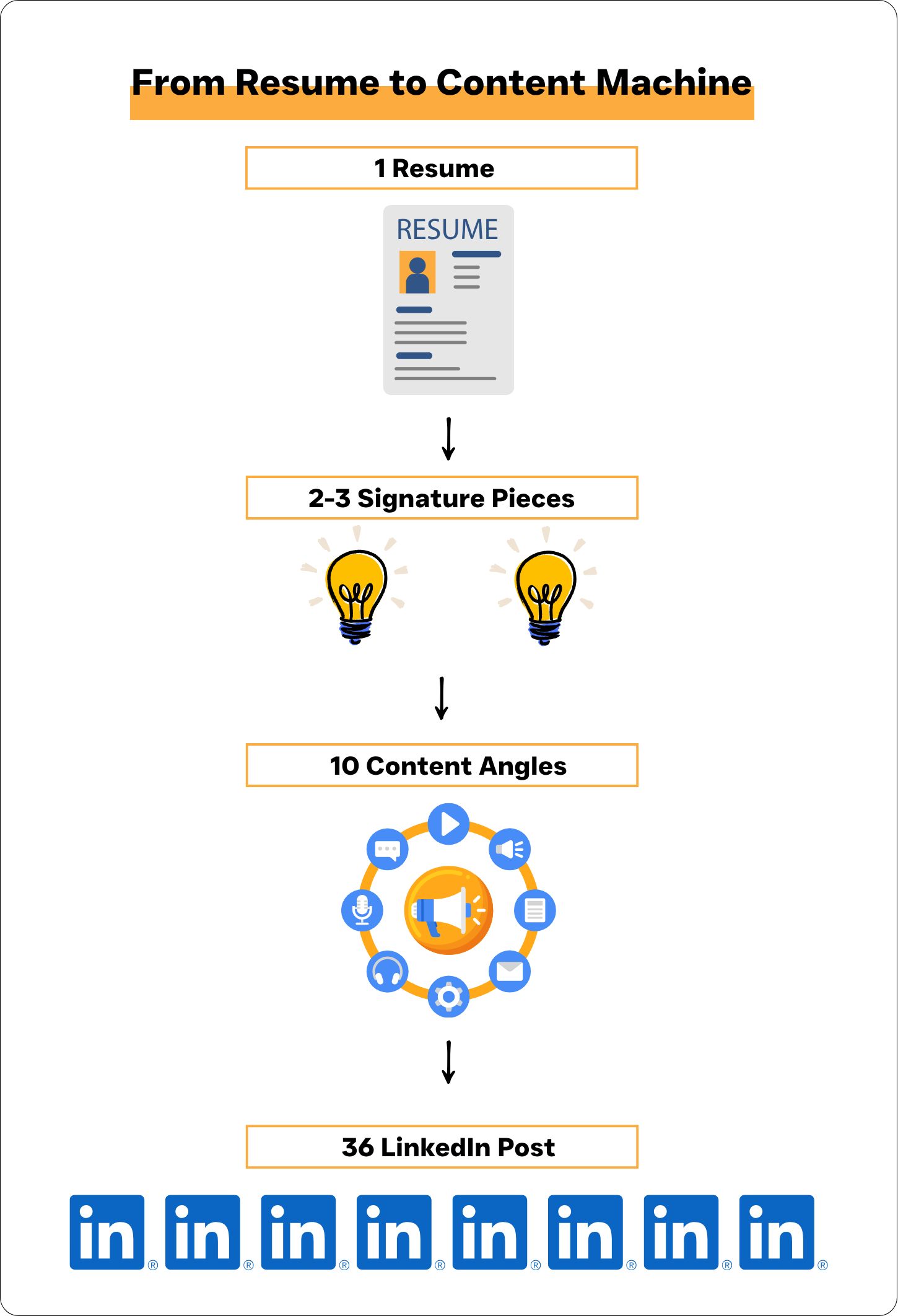
Looking at Jake's resume, he had 12 strong results with numbers.
12 results × 3 content angles each = 36 potential posts.
All from stuff he'd already done. Already proven. Already had the receipts to back up.
The 10 Content Angles Extraction
Third question: "Based on your resume, what are 10 things you could teach someone? What have you gotten good at that others struggle with?"
We made a list of every skill, every challenge, every transition on his resume. Then we turned each into a content angle.
Here are a few examples from Jake's list:
Building processes during rapid scaling
-
Resume Evidence: Did this at Company 2 during hypergrowth
-
Content Idea: "How I built operations systems while the company doubled every quarter"
Managing through acquisitions
-
Resume Evidence: Lived through acquisition at Company 1
-
Content Idea: "What nobody tells you about post-acquisition integration"
Cross-functional leadership without authority
-
Resume Evidence: Multiple projects leading teams from different departments
-
Content Idea: "How to lead projects when you're not anyone's boss"
Each angle is:
-
Tied to something real on his resume
-
Specific (not generic advice)
-
About experience (not theory)
-
Something he could write about authentically
By the end, Jake had 10 of these. He looked at the list and said, "I could write about any of these right now."
"Exactly. And you haven't invented a single thing. It's all already in your resume."
From Content Angles to Signature Pieces
Content angles are individual posts you can write in 30-60 minutes. Signature pieces are your unique approaches developed over years.
Based on Jake's pattern across multiple roles, we identified two:
"The Chaos Operations Framework" - His methodology for building systems during rapid change, refined across all three companies.
"The Cross-Functional Project Playbook" - His approach for leading teams without authority, developed through repeated success.
These aren't generic frameworks. These are methods he developed through real experience. They're defensible because he has the receipts.
Start with content angles. Build to signature pieces as you go.
The Smarter Way: Extract Your Content with This Prompt
Confession time. I may have lied a little bit.
Did we sit in that AirBnb and manually go through Jake's resume line by line? Yes. Did I ask him all those pattern-recognition questions? Absolutely. But did I also use AI to help me bring it all together, extract the patterns, and organize everything into a clean structure?
You bet I did.
The exercise works. The questions work. But doing it manually takes 90 minutes and a friend who knows what they're doing. Or you can use this prompt and get it done in 5 minutes.
Tools needed: ChatGPT / Claude (free or Plus)
Time: 5-10 minutes
Step 1: Upload Your Resume
Copy your resume into ChatGPT or upload it as a file.
Step 2: Run This Analysis
Copy and paste this entire prompt:
I need you to analyze my resume and extract content angles I could write about. Base everything on actual experiences in my resume - don't make up examples or add things not present.

1. PATTERN RECOGNITION
Look at my last 3-4 roles and identify:
- What underlying problem was I actually solving across these roles?
- What type of environment or situation kept showing up?
- What made these roles hard beyond the job description?

Give me:
- A one-sentence positioning statement that captures my specialty
- 3 examples of how this pattern shows up in my resume
- Why this positioning is more compelling than generic titles

2. RESULTS MINING
For each result or achievement on my resume with numbers:
- List the result
- Identify 3-4 content angles hidden in that result
- Format as potential post titles

Focus on results where I:
- Improved a metric
- Solved a problem
- Led a project
- Changed an outcome

3. MY 10 CONTENT ANGLES
Based on my complete resume, give me 10 specific content angles I could write about.

Format each as: "How I [specific thing] in [specific situation]"

Make sure each is:
- Tied to something real on my resume
- Specific (not generic advice)
- About actual experience, not theory

4. SIGNATURE PIECES
Based on my pattern of experiences, what 2-3 "signature pieces" could I develop?

These should be:
- Things I've done across multiple roles
- Processes or approaches I've refined over time
- Topics where I have deeper expertise than a single post

Format: "[Title of piece]: Based on your experience at [companies] doing [thing]"

5. FIRST POST DRAFT
Pick the easiest, most natural content angle from the list above.

Draft a 300-400 word LinkedIn post for me that:
- Starts with a specific moment or problem from that experience
- Tells what happened and what I did
- Shares what I learned
- Uses a conversational, story-driven tone
- Doesn't ask questions at the end
- Doesn't use patterns like "it's not X, it's Y"

---

IMPORTANT:
- Base everything on actual experiences in my resume
- Be specific, not generic
- Don't make up examples or add things not on my resume
- Focus on what makes my experience different or interesting
What This Prompt Gives You:
✅ Your positioning statement (what makes you different)
✅ 20-30 content ideas from your results
✅ 10 content angles you can post about
✅ 2-3 signature pieces to develop
✅ One complete post ready to go
Takes 5-10 minutes while AI does the heavy lifting.
Final Thoughts
That Sunday night in San Francisco wasn't about teaching Jake to be a better writer. It was about showing him that the content was already there, locked in his resume.
Every role you've had is a story. Every result is a lesson. Every challenge you overcame is something someone else is struggling with right now. You're not creating new expertise from scratch. You're extracting what you already built over years of experience.
Stop staring at a blank page wondering what to post about. Open your resume. The content's already there. Try the exercise this weekend. You might be surprised what you find.
That's all for this week.
See you next Tuesday.
~ Ryan & Max
PS - Share this with someone who keeps saying "I should post more on LinkedIn" but never does. They've got more content than they realize.
